


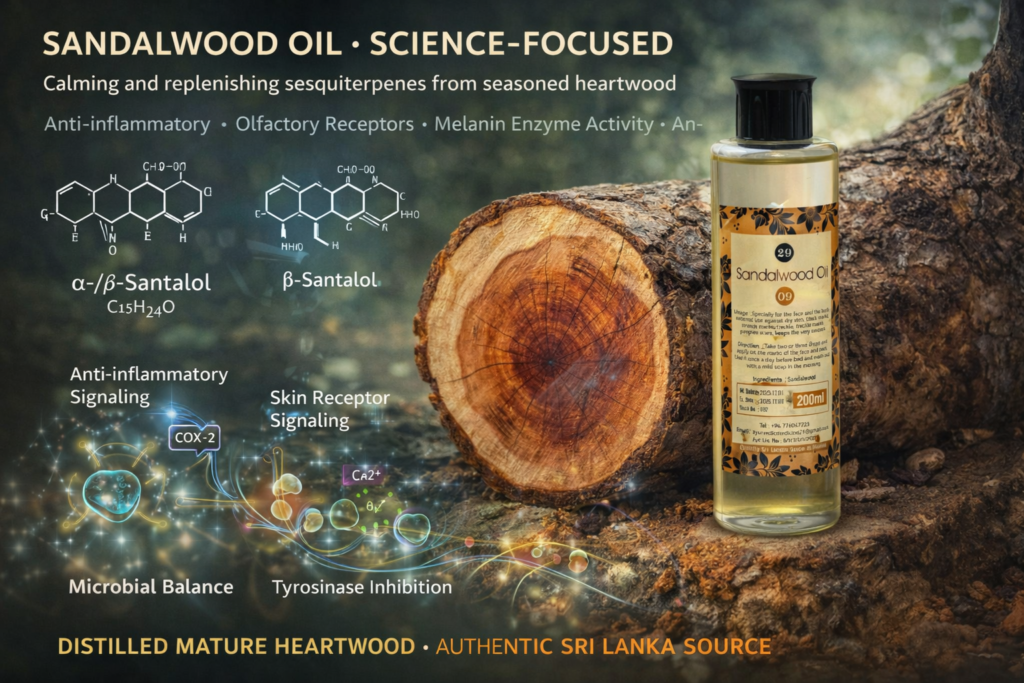
Sandalwood oil is one of the most chemically distinctive plant oils used in topical care. True East Indian sandalwood oil is distilled from the heartwood of Santalum album (not the leaves or bark), and its biological activity is driven largely by a small family of aromatic sesquiterpenes—especially α-santalol and β-santalol.
Below is a clear, evidence-based overview of (1) molecular composition, (2) how these molecules interact with skin biology, (3) what research supports (and what it doesn’t), and (4) how quality and origin—including Sri Lanka—can matter.
1) What sandalwood oil actually is (chemically)
Definition (industry standard): sandalwood oil is an essential oil obtained by steam distillation of chips/billets from the heartwood of sandalwood (commonly Santalum album).
The core molecules
High-quality Santalum album oil is dominated by sesquiterpene alcohols, with α-santalol and β-santalol as the hallmark constituents.
α-Santalol (molecular formula C₁₅H₂₄O)
β-Santalol (molecular formula C₁₅H₂₄O)
Related sesquiterpenes often present: α-/β-santalene (C₁₅H₂₄), bergamotol isomers, etc.
Why this matters
These molecules are lipophilic (oil-loving) and readily partition into the skin’s lipid matrix. That’s important because many skin-relevant biological targets (inflammation mediators, microbial membranes, odorant receptors on keratinocytes) are modulated by lipophilic compounds.
2) What the best research says sandalwood can support in skin biology
A) Barrier comfort + visible redness: inflammation signaling
Multiple dermatology-focused reviews describe Santalum album oil as having anti-inflammatory activity in preclinical models and suggest relevance to inflammatory skin conditions (without positioning it as a cure).
Mechanistic plausibility: sesquiterpene alcohols can influence inflammatory cascades (e.g., eicosanoid-related pathways and cytokine signaling) in cell and tissue models—consistent with why sandalwood is historically used for “soothing” topical applications.
B) Microbiome and “surface clean” feel: antimicrobial effects (preclinical)
Sandalwood oil has documented antimicrobial activity in lab settings, which is one reason it’s studied for acne-adjacent and irritation-prone contexts. Translating lab antimicrobial results to real-world skin outcomes depends on concentration, formulation, and skin sensitivity.
C) A modern discovery: skin has “smell receptors” that can affect repair signals
One of the more fascinating (and genuinely modern) findings is that human skin cells (keratinocytes) express olfactory receptors—and a synthetic sandalwood odorant (Sandalore) can activate OR2AT4, triggering signaling changes associated with keratinocyte migration/proliferation in wound-healing models.
Important nuance:
This specific work uses Sandalore (synthetic), not necessarily natural sandalwood oil.
Still, it supports a credible biological concept: “sandalwood-type sesquiterpene odorants can interface with skin receptors,” which helps explain why sandalwood aromatics keep appearing in skin science discussions.
D) Clinical context (what’s been explored)
A dermatology review on Santalum album oil discusses its activity profile (anti-inflammatory, antimicrobial, anti-proliferative) and summarizes clinical exploration in several skin contexts. This is not the same as “proven to treat,” but it’s meaningful that the ingredient has been studied beyond folklore.
3) “Homeopathic” vs “herbal”: an important clarification (without judgment)
People sometimes use “homeopathic” to mean “natural.” Scientifically, homeopathy refers to extreme dilutions where little-to-no original molecules remain. Sandalwood oil is the opposite: it is a molecularly rich distillate containing measurable actives like α-/β-santalol (C₁₅H₂₄O).
So the best way to describe your product, accurately and credibly, is:
Traditional herbal / Ayurvedic-inspired topical oil
with modern biochemical plausibility and published dermatology research
—not a homeopathic dilution.
4) Extraction: why process and time matter (and where the “10 years” idea likely comes from)
What’s well-documented
The oil is distilled from heartwood, and heartwood formation takes time as the tree matures.
Age strongly affects yield and composition; mature trees generally produce the characteristic santalol-rich profile.
About “burying the wood for 10 years”
I couldn’t find a strong, authoritative scientific source that states “the wood must be buried for 10 years” as a standardized requirement. What is supported in credible literature is that time/age is essential—primarily because heartwood and oil profile develop as the tree matures (often many years).
If this “10-year burial” detail is part of your supplier’s traditional process, the most accurate way to present it on the site is:
“In some traditional practices, sandalwood is seasoned/aged for extended periods before distillation to deepen aroma and consistency. This is a heritage craft detail rather than a universal industry standard.”
That keeps you truthful, protects trust, and still communicates craftsmanship.
5) Quality: how to talk about “authentic sandalwood oil” like a pro
Because “sandalwood oil” is frequently adulterated or substituted in global markets, the scientific way to communicate quality is chemistry + standards:
Botanical identity: Santalum album (East Indian sandalwood)
Chemical fingerprint: santalol-rich profile (α/β-santalol as defining markers)
Standards & verification: many reputable producers verify composition via GC–MS (gas chromatography–mass spectrometry). Peer-reviewed work emphasizes quality variation and the importance of analytical profiling because not all “sandalwood oil” on the market is compositionally authentic.
6) Why Sri Lanka matters in a credible, non-hype way
Sri Lanka is globally recognized for deep herbal traditions and a high diversity of medicinal plant use, with modern research actively cataloging and analyzing antioxidant and bioactive profiles of Sri Lankan medicinal herbs.
From a “trust and authenticity” standpoint for a Sri Lankan-sourced Ayurvedic shop, the strongest, most defensible points are:
Herbal heritage + real research activity around local medicinal flora
Biodiversity and unique ecology that supports diverse botanical resources (Sri Lanka is widely discussed in the scientific biodiversity literature)
Supply-chain transparency: “made and sourced in Sri Lanka” + documentation (e.g., local approvals) is a trust signal—just ensure you phrase regulatory statements precisely and only as documented for each product.
7) Safety and responsibility wording (site-ready, non-alarmist)
Even natural oils are biologically active. The most responsible, evidence-aligned copy usually includes:
“For external use only”
“Patch-test first”
“Discontinue if irritation occurs”
“If you have a known allergy or a skin condition, consult a clinician.”