

This cream is built around a classic Ayurvedic idea: combine botanical actives with a stable, skin-compatible base that improves delivery, comfort, and barrier support. Below is a “molecule-to-function” breakdown that stays grounded in published phytochemistry and dermatology literature—without promising medical outcomes.
1) Botanical identity (no guesswork)
Sri Lankan Ayurvedic sources list the following local names and botanical identities:
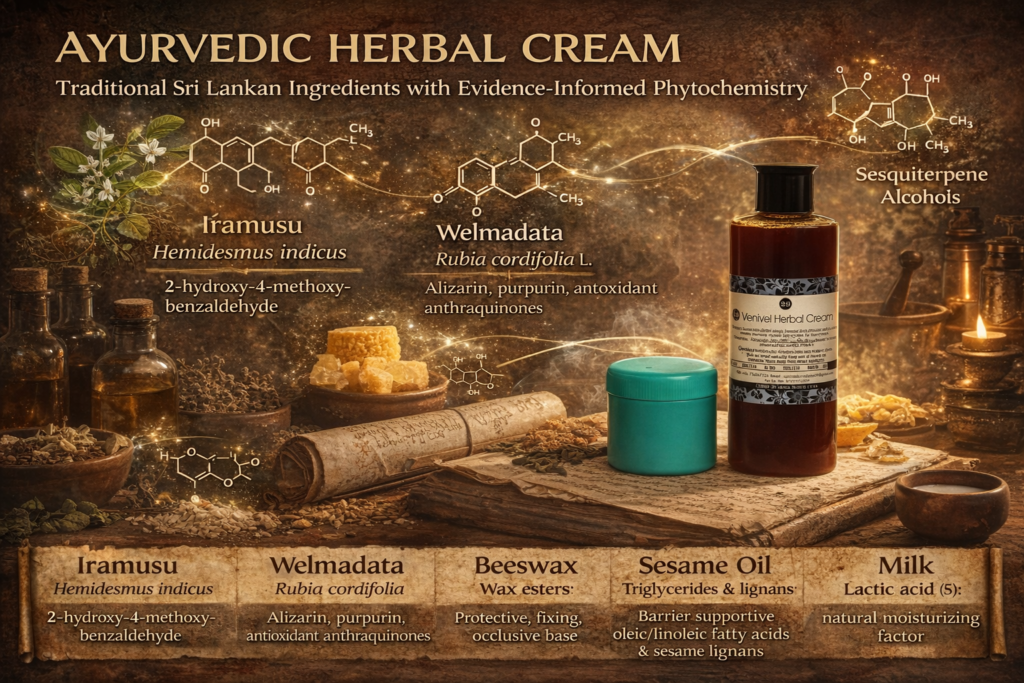
Iramusu → Hemidesmus indicus (L.) R.Br.
Welmadata → Rubia cordifolia L. (Indian madder / Manjistha)
Why this matters: when you know the exact species, you can talk about known compound families (phenolics, anthraquinones, lignans, wax esters) and the types of biological effects that are plausible on skin.
2) The formula, viewed like a chemist (what it es)
Even without seeing the factory SOP, the ingredient list strongly suggests a lipid-dominant topical:
Sesame oil provides a triglyceride “solvent” phase that can dissolve many plant lipophiles and soften skin.
Beeswax thickens/structures the oil phase and forms a semi-occlusive film.
Milk can contribute an aqueous fraction (if emulsified) and adds components associated with moisturization/skin feel (lactate, lipids, proteins—depending on how it’s processed).
Iramusu + Welmadata supply phytochemical fractions (phenolics + anthraquinone-type compounds are common in these species).
This architecture is common in traditional preparations because it can improve residence time on skin, reduce water loss, and create a stable “carrier” for botanical actives.
3) Ingredient-by-ingredient: key molecules → plausible skin-relevant actions
A) Iramusu — Hemidesmus indicus
What it’s known to contain (examples of reported constituents):
Aromatic/phenolic compounds including 2-hydroxy-4-methoxybenzaldehyde (often used as a marker compound for the root)
Broader classes reported across studies include phenolics, tannins, flavonoids (which frequently map to antioxidant/soothing activity) and essential-oil fractions.
Why those classes matter for skin (mechanistic framing):
Many phenolics/flavonoids are studied for redox buffering (reducing oxidative stress pathways that contribute to irritation and visible uneven tone).
Traditional use is often framed as “cooling/soothing”; a modern parallel is modulating inflammatory signaling and oxidative stress at the surface level.
Evidence type note: There is published experimental work on biological activity of H. indicus extracts (including tissue-repair related models), but that does not equal a guaranteed clinical effect for any specific cream.
B) Welmadata — Rubia cordifolia (Manjistha / Indian madder)
What it’s known to contain:
Anthraquinones and related pigments/phenolics (commonly reported examples include alizarin, purpurin, rubiadin, munjistin in the literature on Rubia spp.).
These compound families are frequently investigated for antioxidant y anti-inflammatory potential in lab contexts.
Why that matters for skin:
Some anthraquinone-family compounds are studied for interactions with oxidative pathways and, in some research contexts, targets related to pigmentation biology (e.g., tyrosinase-related assays).
Sri Lanka-specific research signal (relevance):
A Sri Lanka–based study explicitly refers to Welmadata as Rubia cordifolia and reports antimicrobial activity from ethanolic extracts against organisms relevant to skin and superficial infections (lab setting).
C) Sesame oil — Sesamum indicum seed oil
Chemistry highlights:
Sesame oil is mainly triglycerides rich in oleic and linoleic acids (common barrier-supportive fatty acids in emollients), plus characteristic lignans such as sesamin y sesamolin.
A related sesame phenolic, sesamol, has been studied topically for antioxidant/photodamage-related outcomes in preclinical models.
Why that matters for skin feel and function:
A triglyceride-rich oil phase can reduce transepidermal water loss (TEWL) indirectly (by improving surface lipids and reducing roughness) and can serve as a carrier for lipophilic botanical constituents.
D) Beeswax (natural wax)
Chemistry highlights:
Beeswax is largely wax esters, plus long-chain hydrocarbons y fatty acids/alcohols—the chemical basis for its structuring and film-forming behavior.
Why it’s used in topical systems:
Forms a semi-occlusive barrier (helps slow water loss), improves texture, and can increase “stay-on-skin” time—important for botanical topicals.
There are also studies on traditional mixtures that include beeswax in dermatologic contexts (e.g., barrier-support style preparations), but outcomes depend heavily on the full formula and use-case.
E) Milk (dairy fraction)
What’s relevant scientifically:
Milk can contain lactate/lactic acid (an AHA-related component in skincare chemistry) plus lipids and proteins—though the final contribution depends on whether milk is fermented, heated, clarified, or emulsified.
Lactate is part of the skin’s natural moisturizing factor concept and is studied for hydration-related effects.
Why it might appear in a traditional cream:
In traditional systems, milk is often used to soften and to temper strong botanicals; in formulation terms it can also contribute to skin feel and hydration, if present in a stable phase.
4) Why Sri Lanka is a credible place for this kind of formula
Sri Lanka has a long-standing Ayurvedic medical infrastructure and a well-documented tradition of using local medicinal plants; official and institutional resources in the country catalog these botanicals by local name + botanical identity (e.g., Iramusu, Welmadata).
Additionally, comparative research has examined Sri Lankan vs. Indian varieties de Hemidesmus indicus, reporting differences in certain phytochemical signals—supporting the idea that origin and growing conditions can influence composition.