


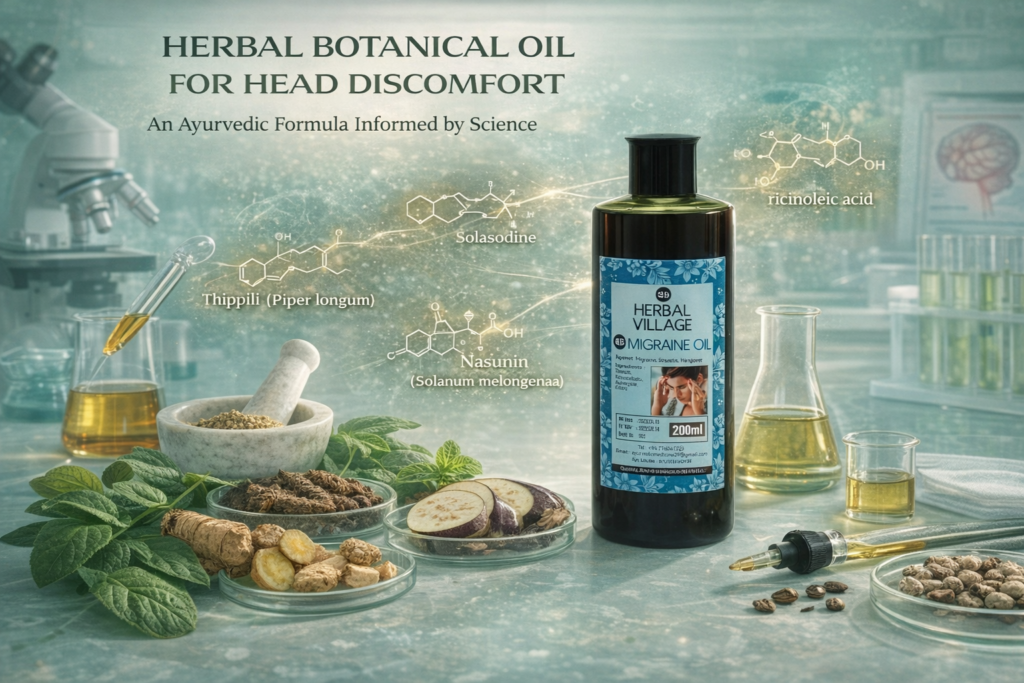
This article is written to be scientific but readable: it connects each labeled ingredient to known phytochemicals and peer-reviewed mechanisms without making medical promises. It also explains why many Sri Lankan Ayurvedic oils are prepared as multi-phase lipid extracts (so the “chemistry” ends up in the oil).
Important note: “Migraine” is a complex neurological condition. A topical herbal oil cannot “treat” migraine in the medical sense. What research can reasonably support is the plausibility of comfort-focused mechanisms (anti-inflammatory signaling, sensory-nerve modulation, antioxidant support, and massage-driven relaxation).
1) What migraine and “sinus tension” discomfort have in common (biologically)
Many people describe head discomfort as “pressure,” often with scalp sensitivity, tight facial muscles, and sometimes sinus-area tension. Biologically, these sensations are strongly linked to:
Neurogenic inflammation and “irritated” sensory nerves in the head/face region (trigeminal pathways).
Local inflammatory mediators (eicosanoids like prostaglandins, cytokines).
Oxidative stress and vascular-nerve signaling that can amplify sensitivity.
So a topical oil is usually positioned around comfort pathways: calming irritated tissues, supporting micro-comfort via massage, and applying lipophilic plant molecules that interact with skin and superficial nerve endings.
2) Ingredient-by-ingredient: botanicals, marker molecules, and evidence-based mechanisms
Below I’m using the most commonly accepted botanical identities for Sri Lankan/Ayurvedic names and citing sources for the name mapping. If your supplier provides a botanical-species certificate (recommended), we can tighten this even further.
A) Thippili → Piper longum (Long pepper)
Thippili is widely used in Ayurveda and commonly identified as Piper longum.
Key molecules (well-studied):
Piperine (alkaloid; marker compound in Piper species)
Why it’s relevant (mechanistically):
Piperine has documented anti-inflammatory signaling activity in preclinical research—often described through down-regulation of pathways such as NF-κB, COX-2, and iNOS in inflammation models.
Piperine is also studied for interaction with sensory ion channels (including TRP-family signaling that relates to “heat/pain” sensation), which is relevant to how topical botanicals can influence perceived discomfort.
What this means in plain English: Thippili’s chemistry is consistent with “calming” inflammatory signaling and modulating surface-level sensory irritation—two things that can matter for head/scalp comfort.
B) Katuwalbatu / Katuwelbatu → Solanum virginianum (syn. Solanum xanthocarpum group)
A Sri Lankan usage mapping identifies “Katuwelbatu” as Solanum virginianum.
Key molecule families:
Steroidal alkaloids (often reported in Solanum spp.; e.g., solasodine-type)
Flavonoids / phenolics (varies by plant part and extraction)
Why it’s relevant (mechanistically):
Reviews and pharmacology papers on this Solanum group commonly describe anti-inflammatory and analgesic (pain-modulating) activity in preclinical models, consistent with traditional use for irritation/inflammation pathways.
Plain English: This is the “anti-inflammatory backbone” herb in many traditional formulas—especially where discomfort and irritation are part of the story.
C) Aubergine → Solanum melongena (Eggplant)
Aubergine is the common culinary name for Solanum melongena.
Key molecules:
Chlorogenic acid (phenolic)
Anthocyanins (e.g., nasunin in peel; antioxidant class)
Why it’s relevant (mechanistically):
S. melongena is studied for antioxidant and anti-inflammatory potential due to phenolics/anthocyanins. These molecules can help reduce oxidative signaling that often accompanies inflammatory discomfort cascades.
Plain English: Eggplant contributes antioxidant phenolics that can support a “calmer” local biochemical environment.
D) Edaru / Endaru → Ricinus communis (Castor)
Sri Lankan sources map “Endaru” to Ricinus communis.
Key molecule:
Ricinoleic acid (the signature fatty acid of castor oil)
Why it’s relevant (mechanistically):
Ricinoleic acid has a documented receptor-level interaction with the EP3 prostanoid receptor, tied to prostaglandin signaling.
Castor oil is also widely discussed as a strong lipid carrier: its fatty-acid profile can help solubilize lipophilic plant compounds and keep them in contact with skin.
Plain English: Edaru/castor chemistry supports the “oil-as-a-delivery-system” idea and contains a signature lipid (ricinoleic acid) with real, documented biological activity. (This does not imply a migraine cure—only mechanistic plausibility for comfort.)
3) Why an Ayurvedic oil format matters (the extraction chemistry)
Many Sri Lankan Ayurvedic oils are made via Sneha Kalpana / Taila Paka logic: combine plant material with a lipid phase (oil), often with a water/decoction phase and a plant paste, and heat gently until the water phase is driven off—leaving a lipid extract enriched with plant molecules.
From a chemistry perspective, this matters because:
Oils extract and retain lipophilic constituents (terpenes, alkaloids like piperine, steroidal molecules, certain phenolics).
The final product becomes a carrier system that can spread easily, stay on skin, and support massage—adding a mechanical relaxation component to the biochemical story.