


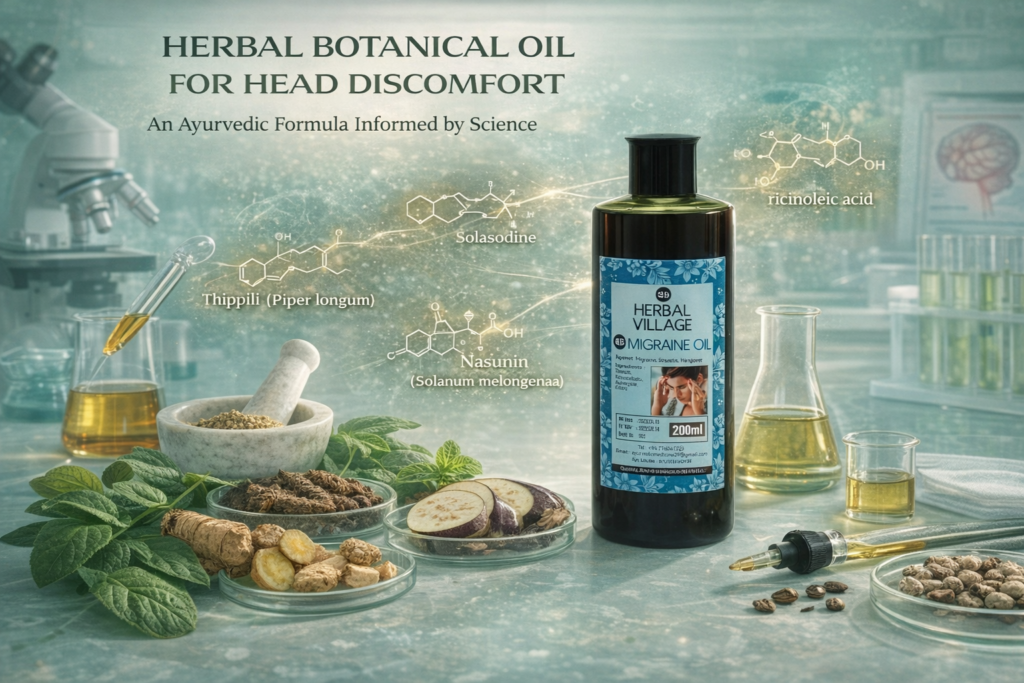
Questo articolo è scritto per essere scientifico ma leggibile: collega ciascun ingrediente etichettato a fitochimici noti e meccanismi sottoposti a revisione paritaria senza fare promesse mediche. Ciò spiega anche perché molti oli ayurvedici dello Sri Lanka siano preparati come estratti lipidici multifase (in modo che la "sostanza chimica" finisca nell'olio).
Nota importante: “L'emicrania è una condizione neurologica complessa. Un olio erboristico topico non può "curare" l'emicrania in senso medico. Ciò che la ricerca può ragionevolmente supportare è la plausibilità di meccanismi incentrati sul comfort (Segnalazione antinfiammatoria, modulazione dei nervi sensoriali, supporto antiossidante e rilassamento indotto dal massaggio).
1) Cosa hanno in comune (biologicamente) l'emicrania e il fastidio da "tensione sinusale"?
Molte persone descrivono il mal di testa come una sensazione di "pressione", spesso accompagnata da sensibilità del cuoio capelluto, tensione dei muscoli facciali e talvolta tensione nella zona dei seni paranasali. Dal punto di vista biologico, queste sensazioni sono strettamente legate a:
infiammazione neurogena e nervi sensoriali "irritati" nella regione della testa/viso (vie trigeminali).
Mediatori infiammatori locali (eicosanoidi come prostaglandine, citochine).
stress ossidativo e la segnalazione vascolare-nervosa che può amplificare la sensibilità.
Quindi un olio topico viene solitamente posizionato intorno percorsi di comfort: calma i tessuti irritati, favorisce il micro-comfort tramite il massaggio e applica molecole vegetali lipofile che interagiscono con la pelle e le terminazioni nervose superficiali.
2) Ingrediente per ingrediente: sostanze botaniche, molecole marcatrici e meccanismi basati su evidenze scientifiche
Di seguito sto usando il identità botaniche più comunemente accettate per nomi dello Sri Lanka/Ayurvedici e citando le fonti per la mappatura dei nomi. Se il fornitore fornisce un certificato di specie botanica (consigliato), possiamo rendere il controllo ancora più rigoroso.
A) Thippili → Piper longum (Peperone lungo)
Il Thippili è ampiamente utilizzato nell'Ayurveda e comunemente identificato come Piper longum.
Molecole chiave (ben studiate):
Pipe (alcaloide; composto marcatore nelle specie di Piper)
Perché è rilevante (dal punto di vista meccanicistico):
Piperine ha documentato segnalazione antinfiammatoria attività nella ricerca preclinica, spesso descritta attraverso la down-regulation di percorsi quali NF-κB, COX-2, E iNOS nei modelli di infiammazione.
La piperina viene studiata anche per l'interazione con canali ionici sensoriali (inclusa la segnalazione della famiglia TRP correlata alla sensazione di "calore/dolore"), che è rilevante per il modo in cui i prodotti botanici topici possono influenzare il disagio percepito.
Cosa significa in parole semplici: La composizione chimica di Thippili è compatibile con la capacità di "calmare" i segnali infiammatori e di modulare l'irritazione sensoriale a livello superficiale, due aspetti che possono essere importanti per il comfort di testa e cuoio capelluto.
B) Katuwalbatu / Katuwelbatu → Solanum virginianum (sin. Solanum xanthocarpum gruppo)
Una mappatura dell'uso dello Sri Lanka identifica "Katuwelbatu" come Solanum virginianum.
Principali famiglie di molecole:
Alcaloidi steroidei (spesso segnalato in Solanum spp.; ad esempio, tipo solasodina)
Flavonoidi / fenoli (varia a seconda della parte della pianta e del metodo di estrazione)
Perché è rilevante (dal punto di vista meccanicistico):
Le revisioni e gli articoli di farmacologia su questo gruppo di Solanum descrivono comunemente antinfiammatorio E analgesico Attività (di modulazione del dolore) in modelli preclinici, coerente con l'uso tradizionale per le vie di irritazione/infiammazione.
In parole semplici: Questa è l'erba "fondamentale" per le sue proprietà antinfiammatorie in molte formule tradizionali, soprattutto quando il fastidio e l'irritazione sono presenti.
C) Melanzana → Solanum melongena (Melanzana)
La melanzana è il nome culinario comune per Solanum melongena.
Molecole chiave:
acido clorogenico (fenolico)
Antocianine (ad esempio, nasunina nella buccia; classe di antiossidanti)
Perché è rilevante (dal punto di vista meccanicistico):
S. melongena viene studiato per antiossidante E antinfiammatorio Potenziale dovuto ai fenoli/antocianine. Queste molecole possono contribuire a ridurre la segnalazione ossidativa che spesso accompagna le cascate di malessere infiammatorio.
In parole semplici: Le melanzane apportano composti fenolici antiossidanti che possono favorire un ambiente biochimico locale più "calmo".
D) Edaru / Endaru → Ricino comune (Castor)
Fonti dello Sri Lanka associano "Endaru" a Ricino comune.
Molecola chiave:
acido ricinoleico (l'acido grasso caratteristico dell'olio di ricino)
Perché è rilevante (dal punto di vista meccanicistico):
L'acido ricinoleico ha un'interazione documentata a livello del recettore con il recettore prostanoide EP3, legato alla segnalazione delle prostaglandine.
L'olio di ricino è anche ampiamente discusso come un forte trasportatore lipidicoIl suo profilo di acidi grassi può contribuire a solubilizzare i composti vegetali lipofili e a mantenerli a contatto con la pelle.
In parole semplici: La chimica dell'olio di ricino supporta l'idea dell'"olio come sistema di rilascio" e contiene un lipide caratteristico (acido ricinoleico) con attività biologica reale e documentata. (Questo fa non implicano una cura per l'emicrania, ma solo una plausibilità meccanicistica per il sollievo.)
3) Perché il formato dell'olio ayurvedico è importante (la chimica dell'estrazione)
Molti oli ayurvedici dello Sri Lanka sono prodotti tramite Sneha Kalpana / Taila Paka Logica: combinare materiale vegetale con una fase lipidica (olio), spesso con una fase acquosa/di decotto e una pasta vegetale, e riscaldare delicatamente fino a quando la fase acquosa non viene eliminata, ottenendo un estratto lipidico arricchito di molecole vegetali.
Dal punto di vista chimico, ciò è importante perché:
Gli oli si estraggono e si trattengono lipofilo costituenti (terpeni, alcaloidi come la piperina, molecole steroidee, alcuni composti fenolici).
Il prodotto finale diventa un sistema di trasporto che si distribuisce facilmente, rimane sulla pelle e favorisce il massaggio, aggiungendo una componente di rilassamento meccanico al processo biochimico.