

1) What varicose veins are (and what a topical product can’t “erase”)
Visible leg veins are usually driven by venous valve dysfunction + venous hypertension. Over time, that mechanical pressure triggers endothelial dysfunction, inflammation, oxidative stress, and remodeling of the vein wall/valves (including matrix metalloproteinases).
Because the root cause is mechanical/structural, topical oils can’t reliably “remove varicose veins” or permanently reverse valve incompetence. What a topical formula can plausibly support is the symptom layer that makes veins look/feel worse on a given day:
local inflammation
skin dryness/irritation
perception of heaviness/discomfort
mild swelling/edema around ankles/calves
Compression is a well-supported first-line approach for symptom control in chronic venous disease.
2) Why “oil + balm ritual + massage” can help symptomatically
Even without “treating the vein,” the combination of emollient barrier support + anti-inflammatory phytochemicals + massage can shift how legs feel and how skin looks:
Massage can temporarily improve lymphatic drainage and local fluid movement, which may reduce the appearance of puffiness and heaviness (especially when swelling is part of the picture).
Occlusive/emollient oils reduce transepidermal water loss → smoother, calmer-looking skin (important because dryness and irritation make veins visually “pop” more).
Anti-inflammatory / antioxidant molecules can reduce superficial inflammatory signaling (COX-2/NF-κB pathways are common targets in preclinical literature), which may improve comfort and skin tone.
This is consistent with modern views that chronic venous disease progression involves an ongoing inflammation–oxidative stress cycle.
3) Ingredient-by-ingredient: chemistry, molecular targets, and what’s realistic
A) Gingerly oil (commonly sesame oil in traditional preparations)
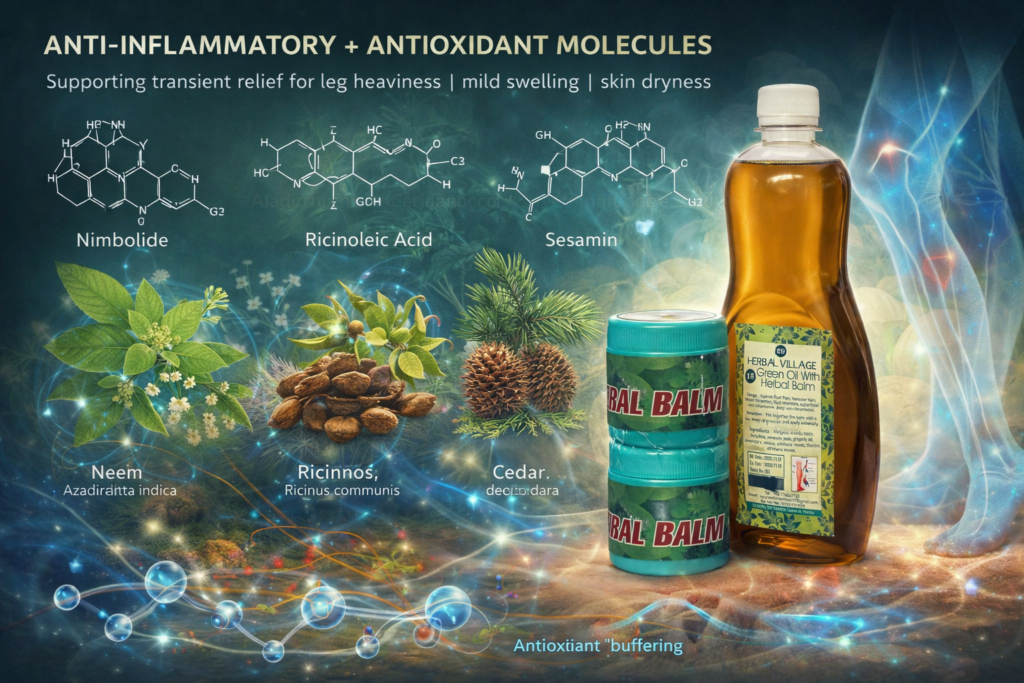
Sesame oil is mainly triglycerides rich in oleic acid (C18:1) Und linoleic acid (C18:2), plus lignans such as sesamin / sesamol (phenolic structures with antioxidant behavior).
Skin barrier effects: natural oils including sesame are discussed as supportive for barrier homeostasis.
Anti-inflammatory signaling: sesamin has been shown (preclinical) to reduce inflammatory markers and pathways (e.g., NF-κB related signaling in skin models).
Plausible benefit: improved skin feel + reduced irritation + antioxidant “buffering” in superficial tissues (supportive, not curative).
B) Margosa (Neem, Azadirachta indica)
Neem contains limonoids (notably nimbolide) and other bioactives often studied for anti-inflammatory and antimicrobial activity.
Recent scientific reviews describe nimbolide’s broad anti-inflammatory potential (often via NF-κB/MAPK/Nrf2-related mechanisms in preclinical models).
Neem overviews summarize anti-inflammatory and antimicrobial activities across extract types (strength varies by preparation and standardization).
Plausible benefit: calming inflamed skin, reducing irritation; potentially helpful when leg skin is reactive/dry.
C) Erandu roots (Castor, Ricinus communis)
Castor oil is notable for ricinoleic acid (a hydroxylated fatty acid; more polar than typical oleic acid, influencing feel and possibly penetration).
Ricinoleic acid is known to activate prostaglandin EP3 receptors (demonstrated in a well-cited mechanistic study).
Plausible benefit: comfort/softening and anti-inflammatory signaling is plausible, though venous-specific outcomes aren’t established.
D) Devadara (Deodar cedar, Cedrus deodara)
Cedar oils contain sesquiterpenes (e.g., cedrol/cedrene-related molecules; composition varies by plant part and distillation).
Reviews note cedarwood essential oil’s anti-inflammatory potential largely attributed to sesquiterpenes, while emphasizing the gap between preclinical findings and standardized clinical outcomes.
A cited study on Cedrus deodara leaf essential oils reports anti-inflammatory activity involving COX-2/TNF-α/NF-κB signaling in a model system.
Plausible benefit: soothing sensation, reduced superficial inflammation, improved comfort.
E) Sawendara / Savandara (Vetiver, Chrysopogon zizanioides)
In Sri Lankan usage, “Savandara/Sawendara” is commonly vetiver.
Vetiver essential oil is rich in sesquiterpenes (complex fragrance chemistry; examples include khusimol/vetiverol/vetiverone families depending on chemotype).
A 2025 review summarizes antioxidant/anti-inflammatory activity and typical constituents.
Plausible benefit: mild anti-inflammatory/antioxidant support + sensory relaxation (which matters for “heavy legs” perception).
F) Nerenchi / Nerenchi-related (uncertain exact botanical)
Sri Lankan “nerenchi” names are used for multiple plants in different contexts. One common “nerenchi / gokatu” mapping is Tribulus terrestris in local naming systems.
Important: I can’t confirm “nerenchi polo” to a single scientific species from your label alone. If you can provide the Sinhala/Tamil name spelling from the product label or supplier sheet, I can tighten this section.
Plausible benefit: unknown until botanical identity is confirmed (don’t overclaim on the site).
G) Atthana leaves / Thunbo (high safety relevance)
Sri Lankan “attana” commonly maps to Datura metel (and “Thunbo attana” is also used locally).
Plants in the Datura/Brugmansia group are known for tropane alkaloids like atropine and scopolamine, which carry real toxicity risk (especially if misused, ingested, or used on compromised skin).
Website recommendation (strong):
If “atthana/thunbo” are genuinely part of the formula, your copy should include clear cautions (patch test, avoid broken skin, avoid pregnancy/children, stop if irritation, consult clinician if sensitive).
And avoid implying “fast elimination” of veins—keep it “comfort/support” language.
4) Why people might think veins “fade faster”
Most “quick change” reports are consistent with:
less surface inflammation
less edema
smoother/hydrated skin → less visual contrast
improved comfort → less attention to veins
Meanwhile, clinical literature for venous disease symptom relief often highlights compression and certain standardized oral/topical agents (e.g., horse chestnut/escin for edema symptoms), which shows that anti-edema/anti-inflammatory strategies can matter symptomatically—even if they don’t “delete” veins.
5) “Homeopathic” angle—how to present this responsibly
If you want to mention homeopathy: major scientific reviews conclude there’s no robust, reproducible evidence that homeopathy works beyond placebo for known diseases.
Better positioning for your site: call this Ayurvedic herbal tradition + plant-based topical care, and keep claims to skin comfort/support.