


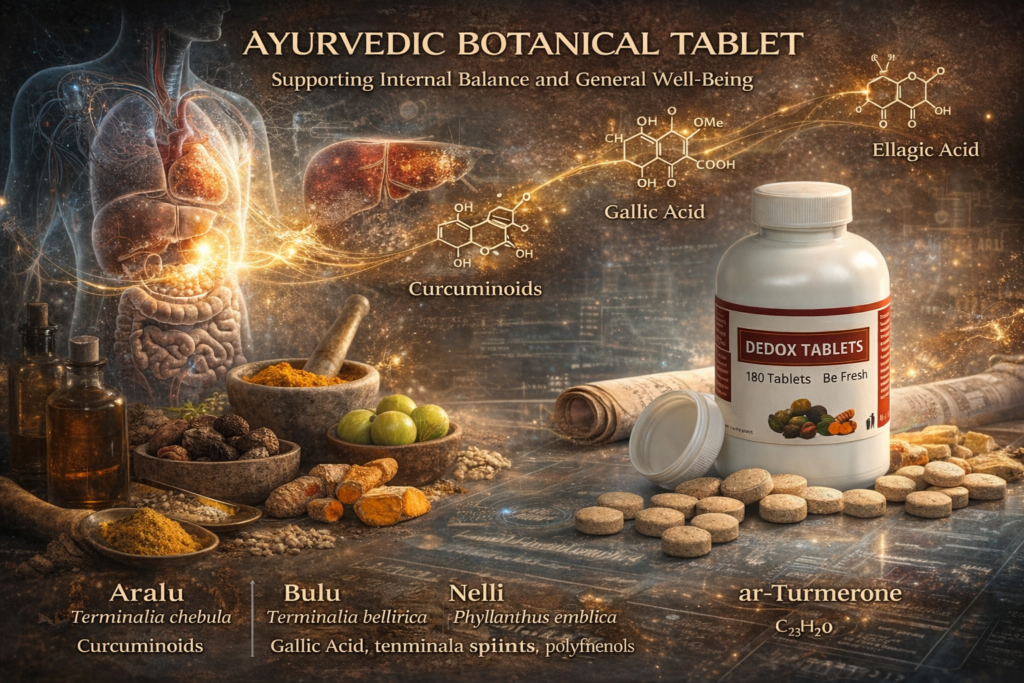
This tablet is built around a classic Ayurvedic botanical combination widely known across South Asia: Triphala—a blend of three fruits—paired with turmeric. While Ayurveda describes these botanicals in terms of balance and digestion, modern research helps explain why they’re biologically active: they’re rich in polyphenols, tannins, and curcuminoids that interact with inflammation pathways, oxidative stress chemistry, and gut ecology.
Below is a clear, evidence-informed overview—focused on known compounds and mechanisms—without making medical promises.
1) What’s inside
Aralu — Terminalia chebula
Key phytochemicals (well-described in the literature):
Hydrolysable tannins / ellagitannins such as chebulagic acid Und chebulinic acid
Gallic acid Und ellagic acid (polyphenols)
Why researchers care (mechanisms that are repeatedly observed):
These polyphenols are studied for antioxidant behavior (electron donation / radical scavenging) and redox signaling modulation, which can influence inflammatory cascades and cellular stress responses.
Bulu — Terminalia bellirica
Key phytochemicals commonly reported:
Polyphenols such as gallic acid Und ellagic acid, plus related derivatives (e.g., methyl/ethyl gallate in some analyses)
Mechanistic relevance:
Research on extracts of T. bellirica has explored effects on metabolic signaling in preclinical models, alongside antioxidant and inflammation-related endpoints.
Nelli — Phyllanthus emblica (syn. Emblica officinalis, amla)
Key phytochemicals commonly reported:
Vitamin C is present, but much of the activity is attributed to tannins/polyphenols such as emblicanin A & B, punigluconin, Und pedunculagin, plus gallic acid and others
Mechanistic relevance:
These compounds are studied for antioxidant effects, including protective effects against oxidative damage in experimental systems, and broader metabolic/inflammation-related activity in reviews.
Turmeric — Curcuma longa
Key phytochemicals:
Curcuminoids, besonders curcumin
Mechanistic relevance (well-established research theme):
Curcumin is widely studied for down-regulating inflammatory signaling, notably pathways involving NF-κB and other signal networks (MAPK, JAK/STAT are frequently discussed in reviews).
2) Why this combination makes biochemical sense
A) “Polyphenol network” effects (not one single magic compound)
Triphala is chemically diverse: it delivers families of polyphenols (tannins, phenolic acids, ellagitannins). These can work in overlapping ways:
Direct antioxidant chemistry (radical scavenging / redox buffering)
Indirect effects by influencing cell signaling that responds to oxidative stress and inflammation
B) Adding turmeric shifts the profile toward inflammation signaling control
Curcumin’s best-known research angle is inflammation pathway modulation (especially NF-κB-related signaling), which complements Triphala’s heavy polyphenol/tannin profile.
C) Gut ecology is a plausible “meeting point”
A growing body of Triphala research discusses outcomes related to metabolic markers and systemic wellness, and many researchers frame botanicals like these as partly mediated through gut-associated mechanisms (polyphenols reaching the gut, interacting with microbiota, and producing bioactive metabolites). This area is active and evolving—but it’s a biologically plausible bridge between traditional “digestive balance” language and modern physiology.
3) What the research can and cannot claim
You’ll see Triphala discussed in systematic reviews and mechanistic papers for outcomes such as oxidative stress markers and metabolic endpoints under specific conditions—but results vary based on extract type, dose, population, and study design. For website accuracy, it’s best framed as:
Traditionally used for internal balance and digestive wellness
Studied for antioxidant and inflammation-related mechanisms, with emerging clinical and metabolic research
Not a guaranteed treatment for any condition
4) A credible production process for an herbal tablet (what “quality” usually means)
A serious botanical tablet isn’t just “plants mixed together”—it’s process control:
Botanical identity & sourcing
Correct species, correct plant part, harvest timing, drying conditions.
Drying + milling
Controlled drying to protect heat-sensitive constituents; milling to consistent particle size.
Blending and/or extraction approach
Some producers use powder blends; others use standardized extracts. Either way, consistency matters.
Granulation + compression
Tablet hardness, disintegration time, and content uniformity are controlled.
Quality control
Screening for contaminants (microbiology, sometimes heavy metals/pesticides depending on regulatory requirements), and manufacturing under GMP-style controls is a common benchmark in regulated production environments.
5) Why Sri Lanka is a natural home for this kind of product
Sri Lanka has a strong institutional relationship with Ayurveda and traditional medicine, including government bodies responsible for regulation and preservation.
It’s also documented as having significant medicinal-plant diversity (with a notable portion endemic), which supports a deep culture of plant-based formulations and sourcing know-how.
(For your site copy, this supports messaging like “rooted in Sri Lanka’s botanical heritage” without overclaiming clinical outcomes.)