


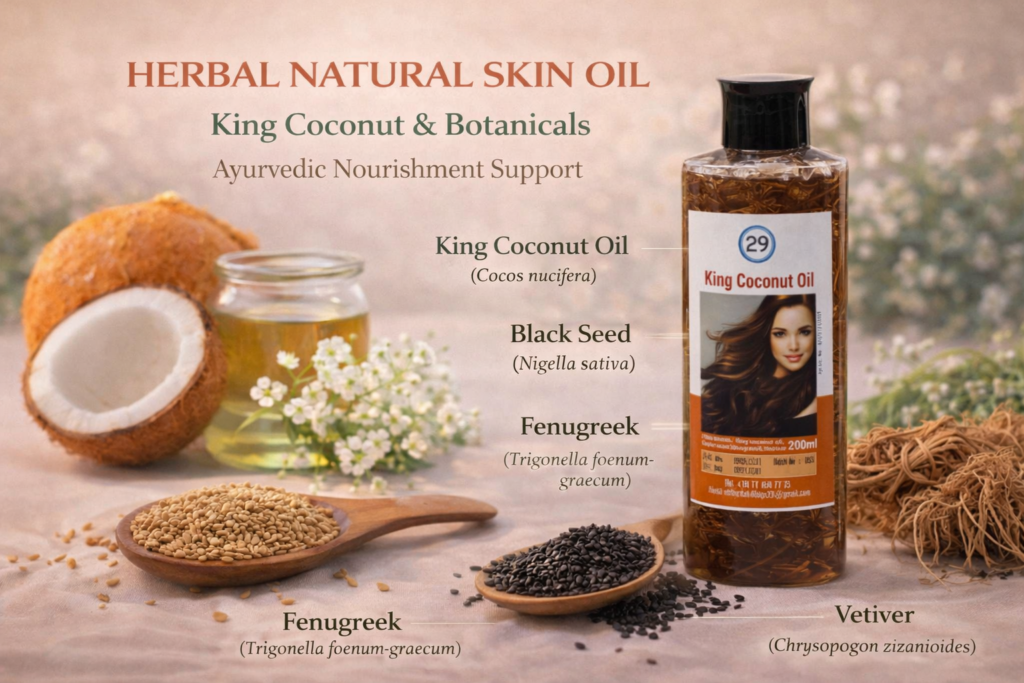
A science-forward look at the botanicals, key molecules, and why an oil-based formula can make sense for skin support—without overpromising.
1) What this formula is, in plain terms
This product is essentially a lipid (oil) carrier—King coconut oil—infused or blended with botanicals that are traditionally used in Sri Lankan wellness and Ayurvedic-inspired body care. From a modern chemistry perspective, the “why it can work” comes down to two big ideas:
Barrier support & lipid replenishment (helping the outermost skin layer hold water and stay resilient).
Bioactive phytochemicals (plant molecules that can influence oxidative stress, microbes on the skin, and inflammatory signaling—mostly shown in lab/early clinical contexts).
2) Ingredient map (botanical IDs you can use confidently)
King coconut oil — Cocos nucifera L. (Sri Lankan “king coconut” is commonly discussed as a distinct cultivar; some literature references C. nucifera var. aurantiaca in Sri Lankan variety classifications).
Black seed — Nigella sativa L.
Fenugreek — Trigonella foenum-graecum L.
Vetiver — Chrysopogon zizanioides (L.) Roberty (syn. Vetiveria zizanioides).
(If you want, I can also format these into an “INCI-style” ingredients section for your product page.)
3) Why the oil base matters (the chemistry of delivery)
Many plant actives that people care about in traditional oils are lipophilic (fat-loving). That means an oil carrier can help with:
Occlusion & TEWL reduction: oils form a thin film that can reduce transepidermal water loss (TEWL), supporting the “moisturized” feel.
Stratum corneum compatibility: the outer skin barrier is lipid-rich; topical lipids can improve barrier feel and comfort.
Solubility & partitioning: compounds like thymoquinone (from Nigella sativa) have poor water solubility, so lipid systems (or advanced carriers like nanoemulsions) are often explored to improve topical performance.
This doesn’t mean “deeper is always better”—but it explains why oil-based traditions sometimes align with what formulation science expects.
4) King coconut / coconut oil (Cocos nucifera): fatty acids, monolaurin, and barrier studies
Key molecules (typical coconut oils)
Coconut oils are rich in medium-chain saturated fatty acids, especially lauric acid (C12:0), plus myristic, caprylic, and capric acids. When lauric acid is converted (in the body or via processing) to monolaurin, it’s often discussed for antimicrobial interactions with lipid membranes.
What research suggests (topical context)
Clinical and dermatology-oriented literature has explored coconut oil as an emollient in dry-skin conditions. For example, a controlled clinical comparison in xerosis has been published comparing coconut oil with mineral oil and found improvements in dryness-related outcomes.
More broadly, peer-reviewed reviews and analyses discuss coconut oil’s emollient properties and potential roles in barrier support and skin comfort.
What you can safely say on a website: coconut-derived oils can support the look and feel of a healthy skin barrier, improve softness, and help reduce the “tight/dry” sensation—without claiming treatment.
5) Black seed (Nigella sativa): thymoquinone and inflammatory signaling
Key molecules
Thymoquinone (TQ) is the signature compound most discussed in Nigella sativa literature. It’s studied for antioxidant and anti-inflammatory pathways (e.g., effects on mediators that intersect with oxidative stress and inflammatory cascades).
The essential oil fraction can also include p-cymene, carvacrol, and related terpenes depending on extraction and origin (composition varies widely by geography and processing).
Evidence in topical/skin-adjacent use
A randomized clinical study in hand eczema compared topical Nigella sativa preparations with standard comparators and reported improvements in severity outcomes—useful as supportive evidence that Nigella may help the appearance of irritated, reactive skin in some contexts (not a guarantee, and not a replacement for medical care).
Formulation science papers also explore topical thymoquinone delivery systems (like nanoemulgels) because TQ’s physicochemical profile makes delivery challenging—again reinforcing why an oil base is a logical traditional approach.
What you can safely say: black seed is rich in studied phytochemicals (notably thymoquinone) that are researched for antioxidant and soothing properties.
6) Fenugreek (Trigonella foenum-graecum): saponins, diosgenin, and skin-relevant biology
Key molecules
Fenugreek seeds contain:
Steroidal saponins (often discussed alongside diosgenin as a key sapogenin-related marker in research literature)
Polyphenols and other antioxidant constituents (profiles vary by cultivar and processing).
Why it’s used in body-care traditions (science framing)
Saponins and phenolic compounds are frequently studied for interactions with:
oxidative stress (free-radical scavenging capacity)
inflammatory mediators (context-dependent; often preclinical)
Direct, high-quality human topical trials specifically for fenugreek are not as common as for some mainstream botanicals; so the most honest positioning is: fenugreek contributes a phytochemical spectrum (saponins/polyphenols) that is widely researched for antioxidant/skin-comfort relevance, and its traditional use fits that biochemical direction.
7) Vetiver (Chrysopogon zizanioides): sesquiterpenes and aromatic-resin chemistry
Key molecules
Vetiver essential oil is dominated by sesquiterpenes and sesquiterpenols, commonly including compounds described as khusimol, vetiverol, and vetivones (names and ratios vary with origin and distillation conditions).
Skin-relevant rationale
These sesquiterpene-rich oils are frequently studied for antioxidant and antimicrobial tendencies in vitro, and they’re valued in topical traditions for their aroma profile and “grounding” sensory effect. Vetiver research also emphasizes composition variability—which is why origin and quality control matter.