


What this formula is (and what we can responsibly say)
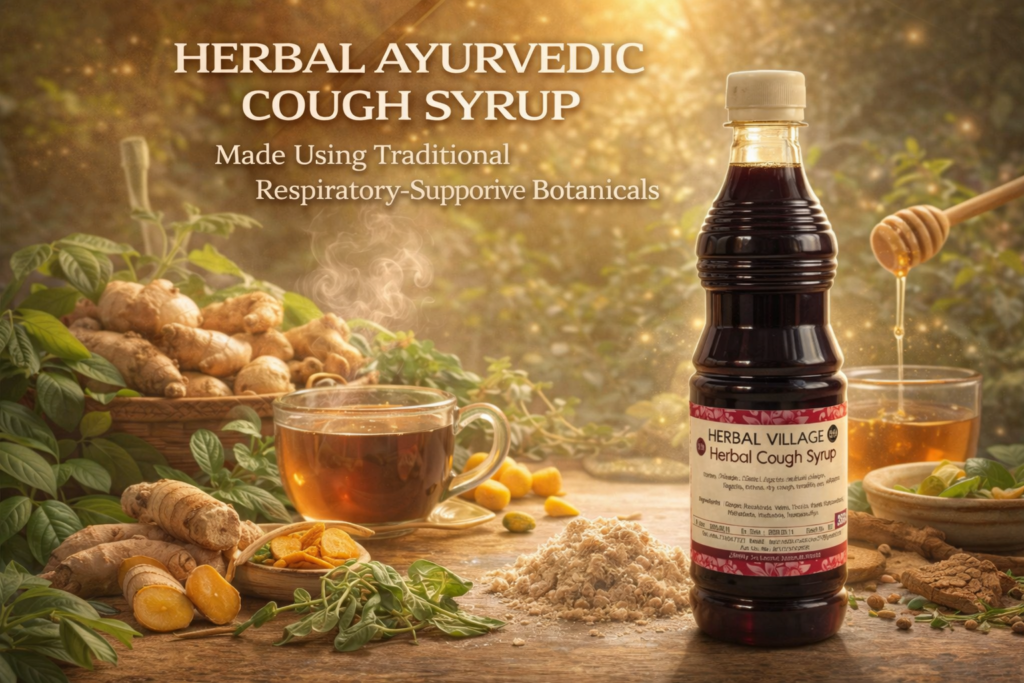
This is a multi-botanical Ayurvedic syrup designed to support respiratory comfort—especially when the throat feels irritated, cough is persistent, or mucus feels “stuck.” From a biomedical lens, most traditional cough blends aim to influence three overlapping systems:
Airway inflammation (irritation-driven cough signaling)
Mucus properties (viscosity, secretion, clearance)
Bronchial tone (tightness, spasm-like sensations)
Because herbal formulas vary by plant species, growing region, and extraction method, the most accurate way to discuss “how it works” is to:
identify each plant precisely,
connect it to known phytochemicals, and
describe the evidence level (cell / animal / human).
Ingredient-by-ingredient evidence (with botanical precision where confirmed)
1) Ginger — Zingiber officinale (confirmed)
Key phytochemicals:
[6]-gingerol, [6]-shogaol, zingerone (phenolic compounds)
Why it matters (mechanistic angle):
Ginger’s phenolics are widely studied for NF-κB pathway modulation, oxidative stress reduction, and effects on inflammatory mediators that can amplify cough reflex sensitivity. In respiratory models, whole ginger extract / 6-shogaol has shown the ability to mitigate allergic lung inflammation and airway hyperresponsiveness in animal research.
How to frame this responsibly:
Ginger is not a “cure,” but it’s one of the better-characterized botanicals for inflammation-linked airway discomfort and is frequently used in traditional systems for warming, soothing respiratory support.
2) Rasakinda — Tinospora cordifolia (high-confidence Sri Lanka usage; confirm with supplier label/spec)
Key phytochemicals:
Diterpenoid lactones (e.g., tinosporide-class),
alkaloids, polysaccharides (immunomodulatory fractions)
Why it matters (mechanistic angle):
Tinospora cordifolia is extensively discussed in pharmacology literature for immunomodulatory and anti-inflammatory activity, including modulation of cytokine signaling and oxidative stress pathways (largely preclinical, with some human data depending on indication).
How to frame this responsibly:
In a cough-support context, its most defensible role is supporting balanced inflammatory response rather than making direct “treats infection” claims.
3) Neeramulliya — Hygrophila auriculata / Hygrophila schulli (commonly referenced as this botanical; confirm exact species)
Key phytochemicals:
Flavonoids, phenolics, phytosterols (varies by species/part/extraction)
Why it matters (mechanistic angle):
In traditional South Asian practice, Hygrophila species are often described as supportive for fluid balance and inflammatory states, and modern reviews commonly explore anti-inflammatory / antioxidant directions (evidence strength varies).
How to frame this responsibly:
This component fits the “systemic support” side of respiratory blends—helping the body cope with inflammatory load—rather than being a direct antitussive claim.
4) Thotila — Oroxylum indicum (strong evidence this local name maps here; still best verified)
Key phytochemicals:
Baicalein, chrysin, oroxylin A (flavones)
Why it matters (mechanistic angle):
Oroxylum indicum is notable because it contains flavones that are studied for anti-inflammatory and antioxidant mechanisms—relevant to irritated mucosa and airway inflammation signaling.
How to frame this responsibly:
This is best described as supporting inflammation modulation and tissue comfort, not as a guaranteed cough suppressant.