

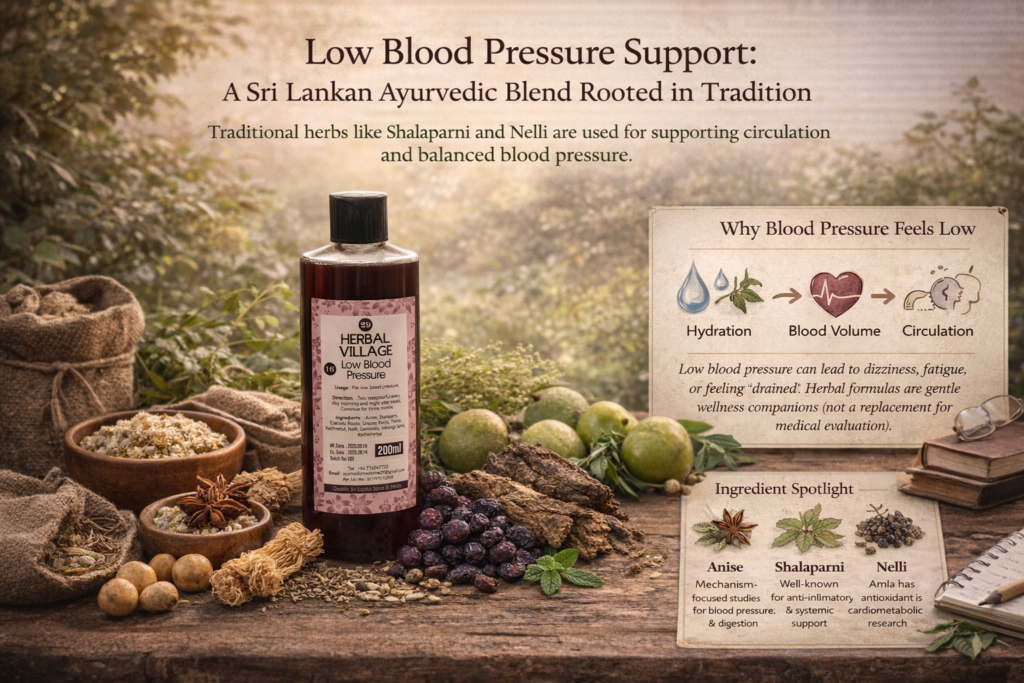
“Low blood pressure support” is a category that needs extra honesty. Based on the currently visible ingredient discussion, the strongest evidence does not show a reliable direct blood-pressure-raising effect. A more accurate interpretation is that this formula functions as a traditional vitality and circulation tonic, not as a proven hypotension treatment.
1) What the evidence actually supports
Several botanicals discussed in this formula have research relevance, but not in the way the product name may suggest:
- Anise has preclinical literature around cardiovascular signaling, but not strong human evidence for treating low blood pressure.
- Desmodium gangeticum is better known in traditional systems for recovery, strength, and systemic support than for a direct pressor effect.
- Amla (Phyllanthus emblica) is more often discussed for cardiometabolic and antioxidant effects, and some clinical literature even points in the direction of blood-pressure lowering rather than raising.
- Embelia ribes and Pterocarpus marsupium have broader metabolic or vascular relevance, but again not convincing human evidence that they correct hypotension.
2) What should be changed in tone
This is exactly the kind of article that can sound more certain than the science allows. The most defensible version is not “these herbs raise blood pressure,” but rather: these herbs belong to traditional tonic systems aimed at overall balance, stamina, digestion, and circulation. That framing is narrower, but it is also more trustworthy.
3) The most credible way to present the product
A realistic public-facing description would be: a Sri Lankan Ayurvedic tonic intended for people seeking a traditional formula associated with vitality, circulation, and general system support. That is safer and more accurate than suggesting it has proven efficacy for symptomatic hypotension.
This distinction matters because recurrent dizziness, fainting, weakness, or very low readings may signal dehydration, medication effects, endocrine problems, anemia, or heart-related causes. Those situations need medical evaluation rather than wellness-style self-treatment.
4) Bottom line
If this article is meant to project trust, it should acknowledge the limit clearly: modern evidence for this blend is stronger for general supportive wellness language than for any direct claim that it raises blood pressure. In this case, being more restrained makes the page more credible, not less.